
How We Use AI for Every Article Without Making AI Slop
Every article we publish at Ahrefs uses AI in some way.We have even built a Letaido pipeline that can research, outline, draft, and fact-check a nearly publish-ready article in six to twelve minutes. In theory, it could produce tens of thousands of articles.
 Si Quan OngSeptember 15, 2026
Do the human work before you draft
For most writers, writing used to be the doing. It was where the hours went. AI has made that part incredibly cheap, so more of our effort has to move upstream: deciding what deserves to be written, how to structure the post, and what we can contribute.
Before I ask AI to write prose, I want a rough premise that answers:
Reader: Who is this for, and what are they trying to accomplish?
Promise: What should they understand or be able to do after reading?
Point of view: What am I actually trying to say, and where might someone disagree?
Evidence: Which claims need sources, data, demonstrations, or expert input?
Information gain: What can we add that isn’t already sitting in the search results?
You can see these are not new. They exist before AI and should exist even with AI.
AI can help to answer those questions. I can ask it to map the SERPs, challenge my angle, find counterarguments, or point out missing evidence. But it shouldn't make those decisions for me.
Planning is only half of it. The model also needs something interesting to work with.
Give it the same internet everyone else has, and it will give you a version of the same article everyone else has. A detailed style prompt won't fix that. You need raw material it could not have produced by itself: interviews, internal knowledge, proprietary data, real demonstrations, failed experiments, and specific examples from your work.
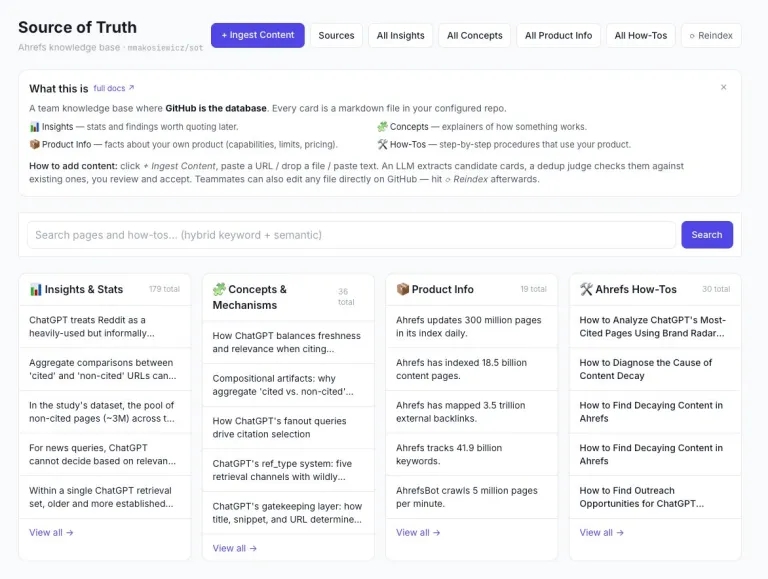
This is where you need things like a Source of Truth for your work. For example, my colleague Mateusz built a Source of Truth app in Letaido: a searchable library for the information that his agent and he rely on when making content.
Personally, the biggest practical change I’ve made is to talk instead of type.
When I type, I edit as I go. I turn the mess in my head into a tidy summary before AI sees it. Unfortunately, the mess often contains the useful part: uncertainty, caveats, opinions, and half-formed connections.
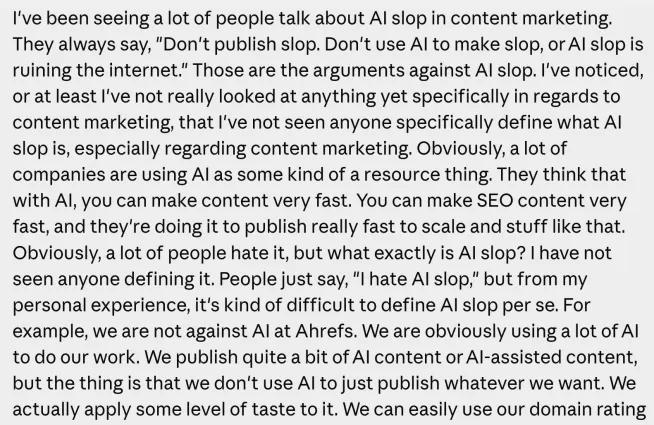
Yes, I basically run a podcast episode with myself. Unedited.

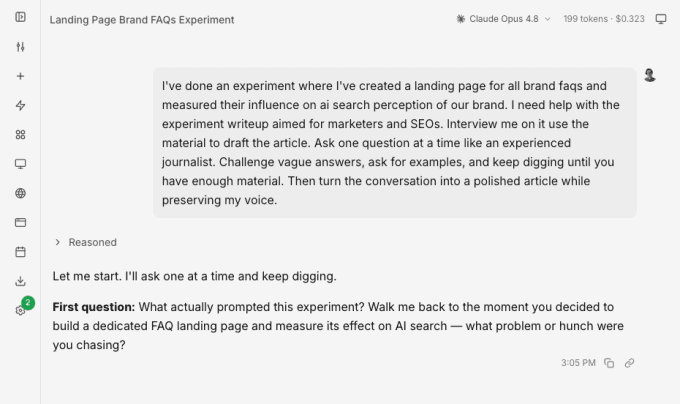
Create places to stop and pass judgment
AI is very good at hiding decisions inside polished prose.
A one-shot prompt chooses the research, angle, structure, claims, examples, and tone all at once. By the time you see those choices, they have been packaged as an article. They feel more settled than they are.
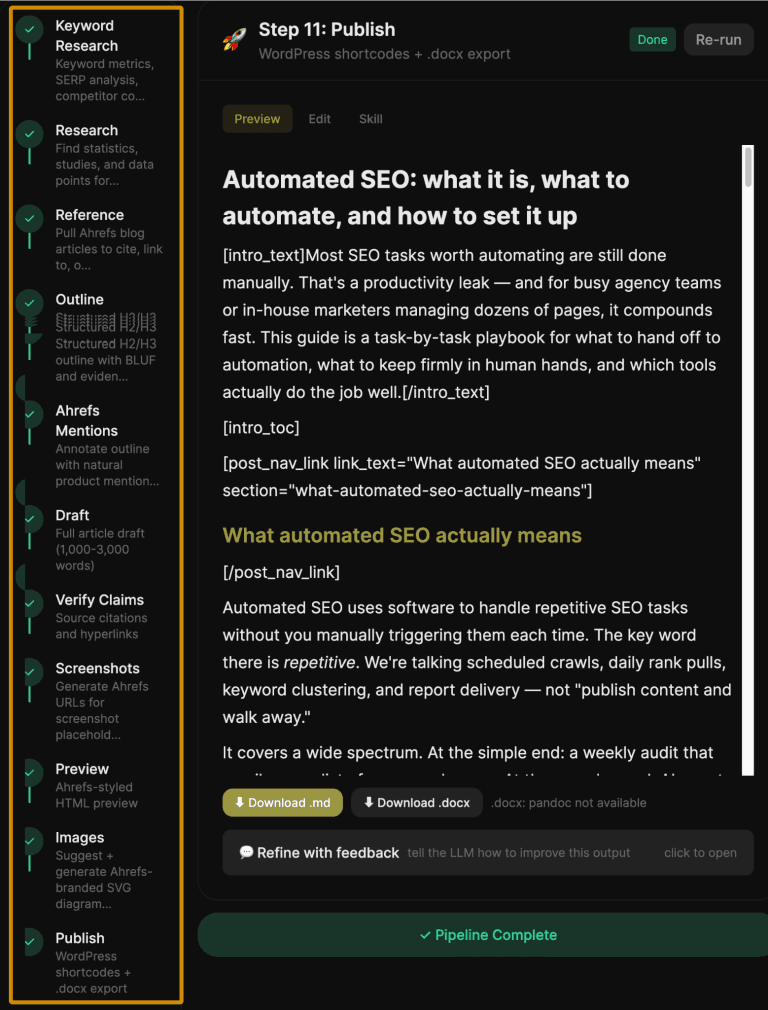
You do not need a 23-skill Claude Code pipeline to copy the principle. Break the work into stages and put a decision between them:
- Idea gate: Do we have something useful to add, or would this article simply repeat what’s already ranking?
- Outline gate: Does every section help the reader and support the article's promise?
- Evidence gate: Can we support the important claims? What still needs testing or verification?
- Draft gate: Has AI smuggled in certainty, filler, or examples we didn't earn?
At every gate, the writer has to pass judgement. That might mean asking for more research, deleting a section, changing the angle, or abandoning the article altogether.
This matters because cheap output creates a strange kind of sunk cost. The moment AI gives you 2,000 polished words, you want to improve them rather than question why they exist.
Sunk-cost fallacy, if you will. Except AI can create the sunk cost every six minutes.
Or if you’re not making a pipeline and are using AI for a single article, break the work into stages. Start by brainstorming first. No drafting. Then, once you’re happy with the angle after the back-and-forth, move to the next stage. Ask it for an outline. Keep working and reworking it with AI until you’re happy, then move to the next stage. You could even ask it to steelman your arguments along the way.
The point is to make better decisions, not to watch the word count go up.
Otherwise, AI turns you into an editor before you've finished being a thinker.
Spend the time AI saves on making better content
I think this is where Ahrefs differs from many companies using AI for content.
The obvious cost-saving play is to produce roughly the same article for less, then spend the savings on volume. More articles. More keywords. More pages for Google to crawl.
To be clear, we use AI to automate tedious work so we can save time too. It would be silly to pretend otherwise.
For example, the Data Refresh Hub I built saves at least a day of manual work each month by fetching, cleaning, and preparing updates for 12 datasets. Work that used to happen quarterly, irregularly, or not at all can now happen every month.
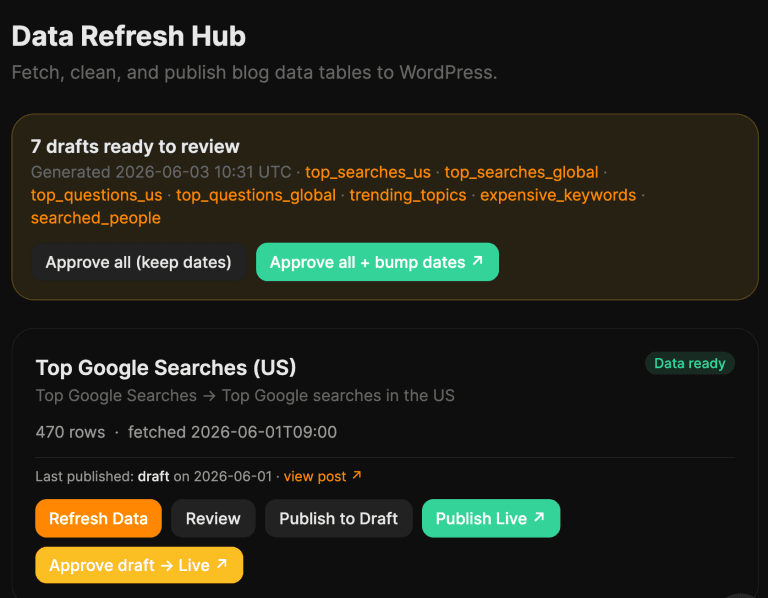
So yes, AI does help us publish and update more.
But volume is not the only possible return on efficiency.
Drafting and publishing were never the only constraints on our content. Often, the bigger constraint was everything we wanted to add around an article but couldn't justify or invest in.
For example, if we wanted to do simple data analysis (not a large scale data study), we might need the help of a data scientist. If we wanted to make a free tool, we needed a developer. A more interactive article needed design and engineering help. A large research project might simply be too manual for one content marketer.

It is also how a basic TablePress embed can become a richer interface for exploring the most-cited domains in AI Mode.
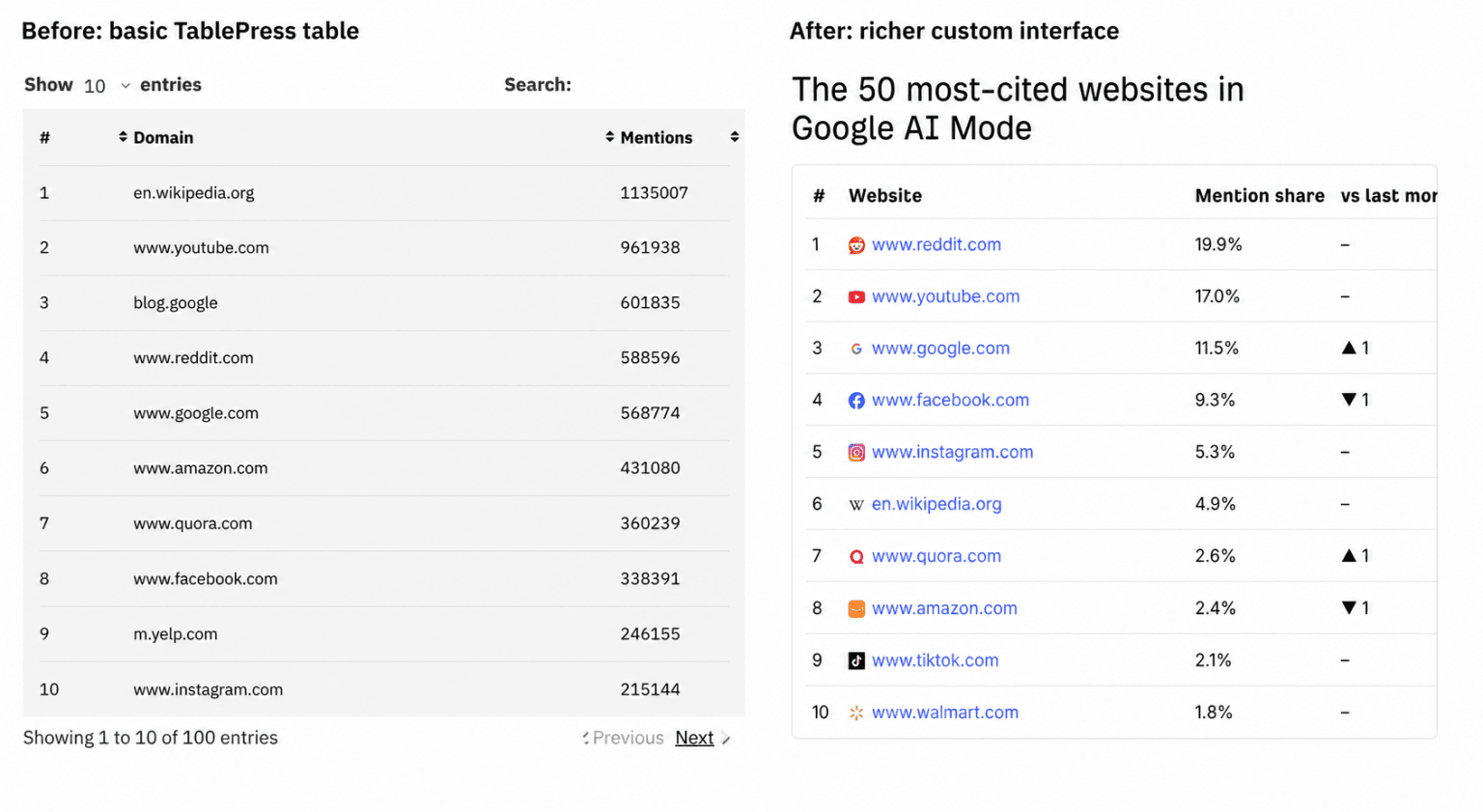
Or how a content marketer can make a quiz, free tool, or data visualisation without waiting for a rare pocket of developer time. Like our free LLMs.txt generator:

This is the distinction we care about. You can use AI to remove the work behind each article, or you can use it to attempt work you previously could not afford to do.
Don't just ask how many more articles AI lets you publish. Ask what you can now put inside an article that used to be impossible.
The capability to scale still needs restraint. We are not trying to turn every writer into a content factory. The goal is to expand what each writer can make without lowering the standard for what deserves to go live.
How common is AI-generated content in the top 10?
Looking at the distribution of AI-generated content across the top 10 positions, highly AI-generated content gets rarer as you move higher in the SERP.
Position 1 has the highest share of low-AI-content pages and the lowest share of very-high-AI-content pages:
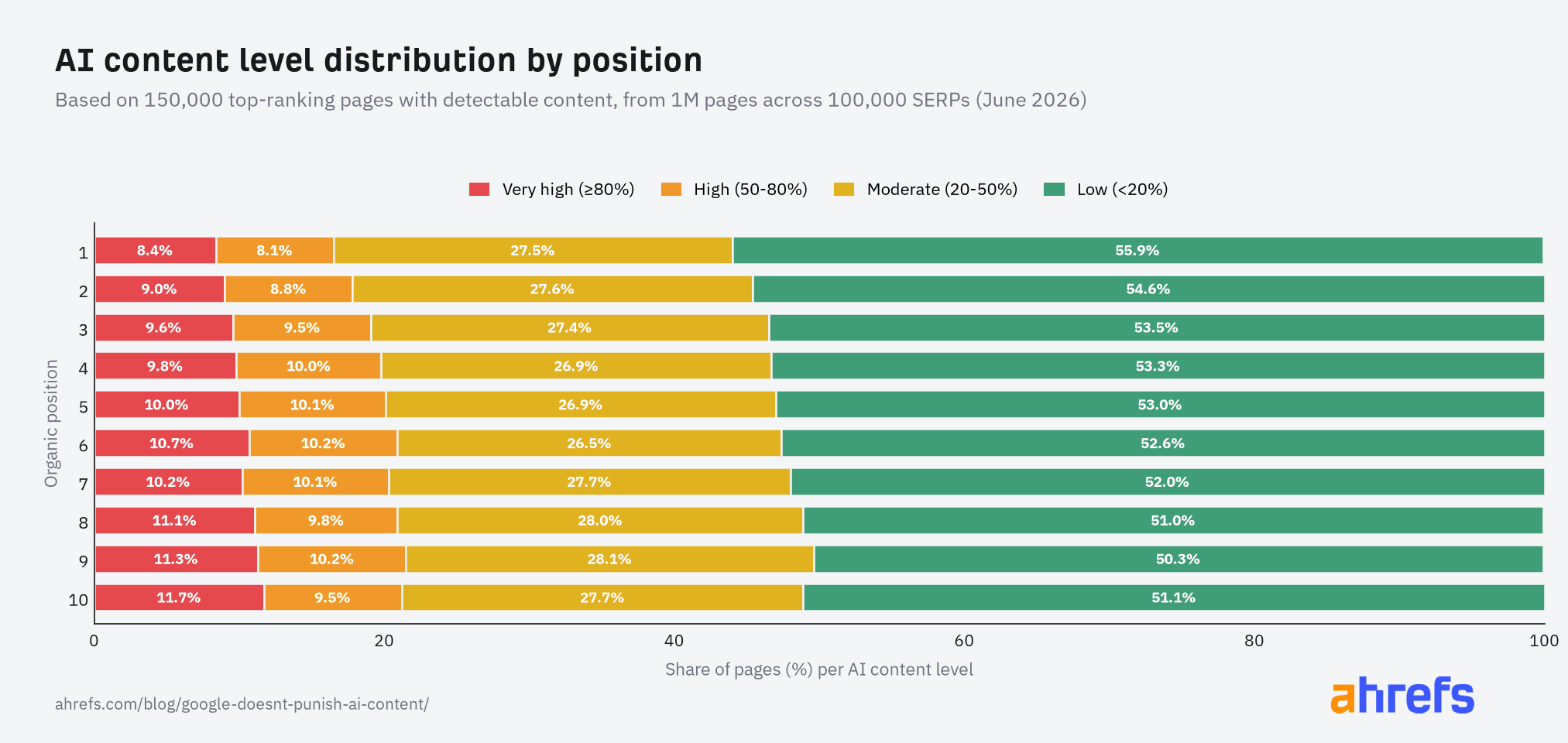
But there is a gentle gradient: the prevalence of AI-generated content gets gradually rarer moving from position 10 to 1, in relatively small increments.
Every ranking position, including position 1, still contains a meaningful share of heavily AI-generated pages: between 8-12% containing ≥80% AI content.
| Position | Very High (≥80%) | High (50-80%) | Moderate (20-50%) | Low ( <= 20% ) |
|---|---|---|---|---|
| 1 | 8.4% | 7.0% | 16.4% | 55.9% |
| 2 | 9.4% | 3.4% | 26.0% | 55.9% |
| 3 | 10.2% | 2.5% | 26.1% | 55.9% |
| 4 | 11.4% | 8.4% | 28.4% | 55.9% |
| 5 | 12.7% | 6.4% | 29.4% | 55.9% |